
- Jul 29
Trapezius Knot? Check The AC Joint For A Solution
- Daniel Lopez
- Everyone, Neck & Shoulders
- 0 comments
You get a massage. The knot between your neck and shoulder is painful when they work on it. By the time they finish, it’s a little better. Then it comes back exactly where it was.
If that pattern sounds familiar, you are not doing anything wrong, and neither is your massage therapist. The knot keeps returning because nobody has addressed the reason it is there.
The knot is there for a reason
We talk about trapezius knots as though the muscle malfunctioned. It did not. A muscle that stays contracted is a muscle doing a job, and it will keep doing that job until the reason disappears. When we have muscle knots, few ever ask, “Why is the muscle doing this?”
Most treatment aimed at these knots works on the knot itself. Massage, injections, stretching, medication, dry needling. All of it addresses the contraction, and none of it addresses why the muscle is contracting in the first place. So the muscle partially relaxes for as long as the treatment lasts, then resumes.
Part of the function of a muscle contraction is to move a joint. If something has gone wrong at a particular joint, the muscle may contract to protect it. Rather than beating up the muscle trying to protect a joint, the better solution is to address the source of the muscle contraction and restore proper function to the joint.
The question worth asking is not how to get the trapezius to let go. It is why the trapezius decided to hold on.
The joint almost nobody checks
Your trapezius attaches to your collarbone and your shoulder blade. Where those two bones meet, at the outer end of the collarbone, is the acromioclavicular joint. The AC joint.
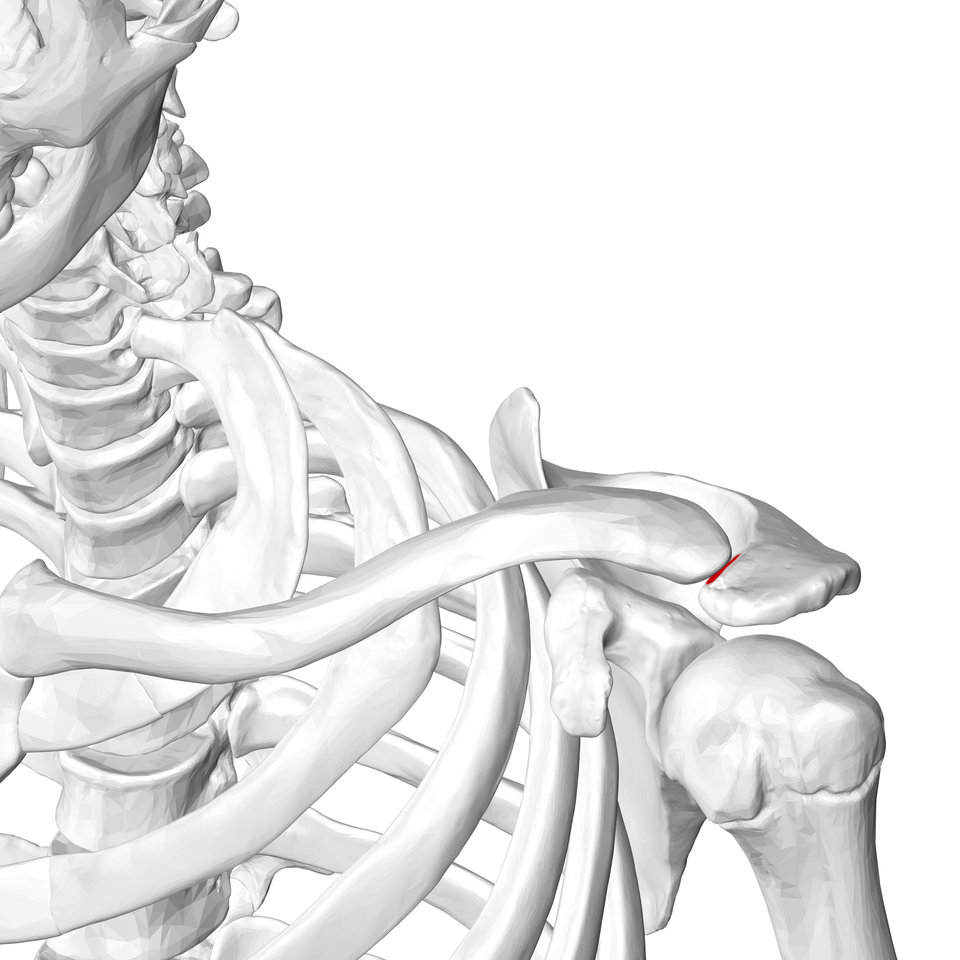
When your upper trapezius contracts, it produces motion at that joint. That relationship runs in both directions. If the AC joint is not moving the way it should, the trapezius can contract to limit motion there and keep the joint from being pushed further into trouble. The knot is a splint.
Here is why it gets missed so consistently: a dysfunctional AC joint usually does not hurt. It is quiet. You feel the trapezius screaming and you have no sensation at all from the joint the trapezius is protecting. So you point at your neck and shoulder, your practitioner treats your neck and shoulder, and the actual problem is an inch or two away, silent, untouched.
Think about a backpack with the straps pulling down right across the tops of both shoulders, or a bag you always carry on the same side. The pressure lands directly over these joints. The joint stops moving well. The trapezius takes up its post. And it stays there.
Check it yourself in about thirty seconds
Before you do anything, get a baseline so you can tell whether something changed.
Step one. Squeeze the fleshy area between your neck and the top of your shoulder, on the side that bothers you. Tender, tight, ropey? Note how it feels. That is your before.
Step two. Find your collarbone and trace it outward, away from your throat, until you reach the end. You will feel a small bump or a slight step where it meets the shoulder blade. That is your AC joint. If you would rather work backward, feel along the top of your shoulder for the bump.
Step three. Take that bump between your thumb and index finger and wiggle it gently back and forth.
Pay attention to what happens over the first several seconds. Very often it feels like nothing at first, and then a tenderness surfaces that was not there when you started. That hidden tenderness is the finding. It means the joint was not moving well and you have just woken it up.
The release
Keep wiggling gently until the bump moves more freely than it did when you started.
How long: Thirty seconds to a minute.
How often: Every 2 days as needed.
How much pressure: Gentle. You are freeing up a small joint, not forcing it. If you have any history of injury or separation at that shoulder, start lighter than you think you need to and see how it responds.
How long to keep going: Until the joint stops being tender and moves freely. For many people that is a handful of days.
Now go back and squeeze your trapezius again. Compare it to your before.
Most people notice the difference immediately. Some notice it the next morning.
What is normal afterward
The AC joint feels sore the next day. That is common and not a problem. If it gets too sore, leave it alone for a few days until the tenderness settles, then go back to it.
You hear or feel clicking. The AC joint can click when you move your arm back and forth. That can be the joint itself, though clicking has other causes too and can point to instability in the shoulder.
You break out in a light sweat while doing it. Unusual but harmless. It suggests the release is having an effect on your autonomic nervous system, the part that runs your body without your involvement.
It works, and then a strand of tension remains. Very common. It means the AC joint was part of the picture and not all of it. Keep reading.
If a few tries did not help, look elsewhere
This is the part I want to be honest about. The AC joint is a common cause of a stubborn trapezius knot. It is not the only one, and I would rather you look elsewhere than keep working a joint that is not your problem.
If you have done this a few times with no change, here is where I look next.
The first rib and the collarbone. The first rib can press up under the collarbone, or the collarbone can push down onto the first rib. Nerves and blood vessels pass through that space, so when it narrows you tend to get symptoms that travel down the arm rather than symptoms that stay in one place.
A rib that is not moving well. Pain near the shoulder blade is often a rib underneath rather than the muscle on top, and a rib that is not moving well commonly refers pain up into the neck. This includes the area under the shoulder blade itself, which is awkward to reach and almost nobody checks.
The chest and the pecs. Tension in front pulls the shoulder forward, and everything behind it has to work harder to hold you up.
The lats and under the armpit. The fleshy muscles at the back edge of your armpit, and the area tucked underneath it. They connect your arm directly to your low back and pelvis, which is why a shoulder problem sometimes starts a long way from the shoulder. Frequently tender, rarely checked.
The fifth one surprises people: your tongue
A fascial layer continuous with the tongue anchors at the base of your skull, in front of the vertebrae. It is the strongest fascial layer in the body. From there it runs down through your neck and anchors firmly into your rib cage and diaphragm.
Picture a rope running between the base of your skull and the base of your rib cage, normally with enough slack to let you move freely. A tongue tie shortens that rope. Because the anchor below is much stronger than the anchor above, the rib cage does not get pulled up. Your cranial base gets pulled down and forward.
That is forward head posture. And once your head lives out in front of your body, the muscles across the tops of your shoulders are holding it up all day long. That is a trapezius that never gets to clock out, and no amount of work on the knot will change it while the rope stays short.
If your knot sits on both sides, if it has been there for as long as you can remember, or if you also deal with headaches, jaw tension, poor sleep, or mouth breathing, this is worth ruling out.
To be clear about what is established and what is mine: the fascial anatomy above is well described. The idea that a tongue tie shortens that layer enough to drive forward head posture is a mechanism I am proposing based on anatomy and on what I see clinically. It has not been formally studied.
Each one has a self-check you can do at home.
Not sure which one is yours?
I put all five checks into a short guide: where to put your hands, what you are feeling for, and what a positive finding actually feels like. It is the answer I have given most often in ten years of questions on this article.

When you need someone else’s hands
I want to be straight with you about the limits of what an article can do.
If you have had a shoulder surgery, a separation, a fracture, or a tear, the anatomy has been changed. It may have healed and still not work the way it was designed to, and your trapezius may be tightening in response to a structure that is permanently different. Self-release will not undo that or undo it permanently.
Please get evaluated in person rather than working on this alone if you have:
Numbness, tingling, or weakness in your arm or hand
Pain that keeps escalating despite everything you have tried
Swelling, discoloration, or temperature changes in the limb
A known tear, separation, or hardware in that shoulder
Any lump you have not had a doctor look at
Numbness and tingling in particular are worth taking seriously. They usually do not come from the knot. They come from whatever is causing the knot, and when that goes unaddressed for years it tends to progress.
To find someone who works this way, try findomm.org or cranialacademy.org. Look for an osteopathic physician who practices osteopathic manipulative medicine. Not every DO does, so it is worth asking directly. If you happen to be in the Denver area, this is what I do, and you can find my practice here.
What I want you to take from this
A muscle in spasm is not the problem. It is an effect of a problem.
You can spend years treating the effect. Plenty of people do, and they get a few days of relief at a time, indefinitely. Or you can start asking what the muscle is protecting, and go there instead.
The AC joint is the first place I would look. It takes thirty seconds to check and costs nothing to rule out.
Want the rest of the sequence?
The Neck Pain Code covers the self-releases I use for neck pain and knots, in the order I use them, including several of the areas above.
Daniel Lopez, DO is an osteopathic physician in Denver, Colorado, specializing in osteopathic manipulative medicine. He is the author of Digging Deeper, Unwinding the Body, and An Osteopathic Approach to the Eyes, and teaches courses for physicians and manual therapists internationally.